Of all the terms you'll come across in options trading, a put is one of the simpler concepts to understand. (Other strategies—such as naked calls, long straddles, and long strangles—can be more complex.)
A put gives you the right (but not the obligation) to sell a stock at a set price (the "strike price") by a set date. In this article, we'll cover what put options are, how they work, why investors buy and sell them, and the risks involved.
What is a put option
A put option gives you the right to sell a stock at a specific price by a specific date. You're not obligated to sell — if the market moves against you, you can simply let the contract expire or consider rolling your options to a later date.
Put options are generally used for two main reasons: to protect an existing portfolio against a drop in the market, or to speculate and potentially profit from a stock's decline without having to purchase the stock directly.
What are options
Options are a type of financial contract known as a derivative. That means they are based on the price of an underlying stock, but they don't actually give you any ownership of any of those assets.
Options are traded separately from stocks and have their own valuation based on several factors, including the price of the underlying shares, supply and demand, and how much time is left before an individual option contract expires.
The price of an option contract is called the premium. It's quoted per share and typically represents 100 shares (e.g. a contract with a $5 premium would cost $500). The strike price is the set price that the stock or commodity can be bought or sold at before the contract expires.
Options are flexible investment tools that serve a few key purposes:
Hedge against losses: can help to protect against potential price drops in stocks you own.
Lock in future prices: lock in a purchase price for a stock you plan to buy later.
Generate income: potential to collect premiums by selling options contracts.
How put options work
Here's what buying a put option contract could look like in practice (before any fees and commissions):
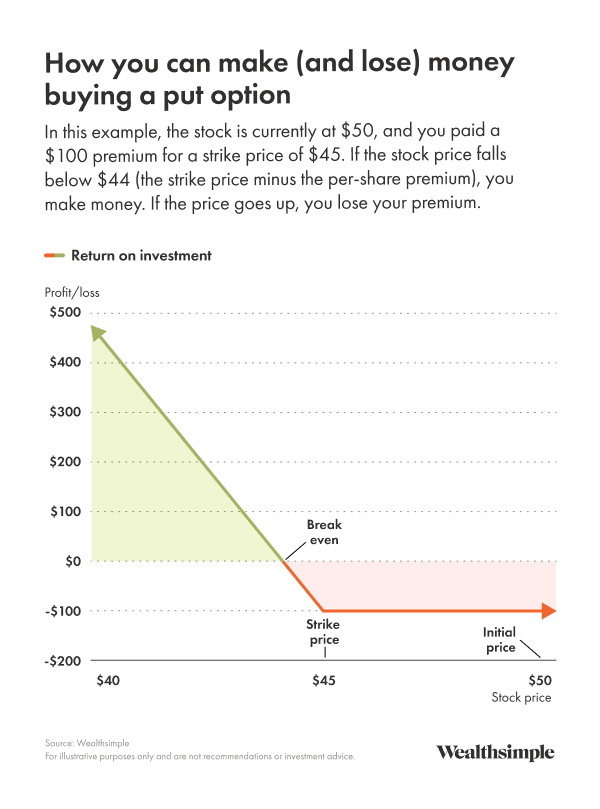
Let's say you have a stock that's priced at $50 per share, but you expect the price could drop to $40 per share in the near future. You purchase a $45 put option for a premium of $1 per share, or $100 total.
If the stock price drops to $40 per share by the expiry date like you predicted, you have the right to sell your shares at $45 each even though they're currently trading at $40. In this scenario, the seller of the put would have to buy the stock from you at $45 per share, and they'd incur a $4 loss per share (the $5 difference in the strike price and current purchase price, minus the premium of $1 per share they made from selling the option). However, you would net a $4 profit per share.
If you bet wrong, and the stock price doesn't drop below $45 by the expiry date? You lose the $1 per share premium you paid and the put option seller keeps that $1 per share as a profit.
Why would someone buy a put option?
Buying a put option is akin to shorting a stock, or betting that the stock's price will decline. This makes it a bearish strategy. But there are two important differences between shorting a stock and buying a put:
A put option contract has an expiry date. A short stock position does not.
Losses for a put option are capped; the maximum loss you'll face over a put is limited to the premium you paid for the option plus any fees and commissions. When you short a stock, however, there's no cap on how high the price of the stock might go, which means there's no limit to how much you can lose.
If the stock price drops below the strike price before the expiry date, you — as a buyer of the put and owner of the underlying stock — can exercise your right to sell the stock, above the market price. If you don't own the underlying stock, the alternative is to sell the put option before the expiry date and potentially earn a profit on the premium collected from the sale (though you'll want to understand the capital gains tax implications).
There are a couple main reasons investors buy put options:
Hedge against losses: use put options to help offset losses if the market declines or a specific stock drops.
Speculate on a decline: use a put option to express a bearish view without shorting the stock directly.
Why would someone sell a put option?
The main goal for selling (or ‘writing’) put options is to earn a profit from the premium charged for writing the options contract, which is collected whether or not the buyer exercises the option.
When you sell a put option, you are obligated to buy the stock at the strike price from a buyer if they decide to exercise the option to sell the stock by the expiry date. Your break-even point occurs at the strike price, minus the premium you charge for the contract.
This is known as a "short put." You stand to make a profit from the premium you charge for the put option so long as the price of the stock doesn't fall below the strike price in your contract.
However, if the stock price falls below the strike price, you may have to purchase the shares at the strike price, which would likely result in a loss.
Put options vs. call options
Call options are basically the opposite of put options. Here's how they compare:
Put options: Give you the right to sell a stock at the strike price. You profit when the stock price declines (short position).
Call options: Give you the right to buy a stock at the strike price. You profit when the stock price increases (long position).
How put option premiums work
The price you pay to purchase a put option contract is known as the premium. This cost is not arbitrary — it is calculated based on a few specific factors.
Three main factors determine a put's premium:
Stock price vs. strike price: If the stock is already trading below your strike price, the option has intrinsic value and costs more
Time until expiry: More time means a higher premium, since there's a longer window for the stock's price to drop
Implied volatility: Stocks with larger price swings typically carry higher premiums because the likelihood of a significant price drop is greater
Types of put options
There are plenty of different kinds of put strategies (many with weird names, like a bear put spread, or a married put). Covered puts and naked puts are two of the most common — and if you're familiar with covered calls, the concept is similar.
Covered put options
With a covered put, you're selling the right to sell a stock at the strike price until the option expires — while holding a short position in the same stock (meaning stock you already own). It's all a bit complicated, so let's look at an example.
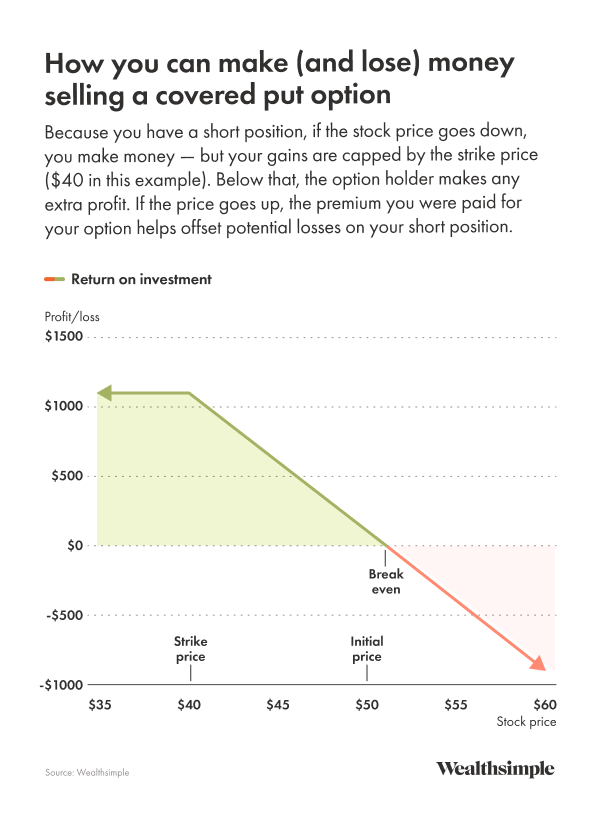
Say $PEAR is trading at $50 per share. You have a pretty good feeling that the price is going to fall a lot in the long term, and maybe just a little in the short term, so you decide to short the stock. You borrow 100 shares from a brokerage and immediately sell them for $5,000, with the goal of buying them back later at a lower price to turn a profit.
Then you sell a put option of 100 shares. You set the strike price at $40, with an expiry date of 30 days from now. You make a premium of $1 per share upfront just for selling the put option. Here's what happens based on a few different scenarios (before any fees and commissions):
The stock price drops to $45: The put option you sold expires worthless because the stock price is higher than the strike price of $40. Because you have a short position and sold the stock at $50 per share, you're going to make a $5-per-share profit, plus the $1-per-share premium you made for selling the put option. That's a $6-per-share ($600 total) payday.
The stock price drops to $35: At the expiry date, $PEAR is $35 per share, which is less than the strike price of $40. The investor who bought your put option exercises their right to sell you the 100 shares at $40 per share, or $4,000 total. Yikes. But wait! That loss is buffered by your short position, which has now gained $1,500. So your total profit would be $1,100 ($1,500 for the gain on your short position, minus $500 for the loss on your put, plus $100 for your initial premium).
The stock price skyrockets to $60 per share: The put option you sold expires worthless (because the stock price is now higher than the strike price). You've made a profit on the premium, but now you're underwater on your short position.
You can buy back the 100 shares at the new price (this is called covering your short position), locking in a $900 loss (the $10 difference in stock price for the 100 shares you shorted, minus the $100 profit from the option premium). Or you can wait in hopes that the price will come back down again (this is called holding your short position, and it's risky, since prices could keep going up).
Naked put options
With a naked put, you're selling the right to sell a stock at the strike price until the option expires. This means that, if the stock price falls, you are obligated to buy the stock at the specified strike price, regardless of its current price. If the stock price rises, there's no reason for the person who bought the option to exercise it, so you get to keep the premium.
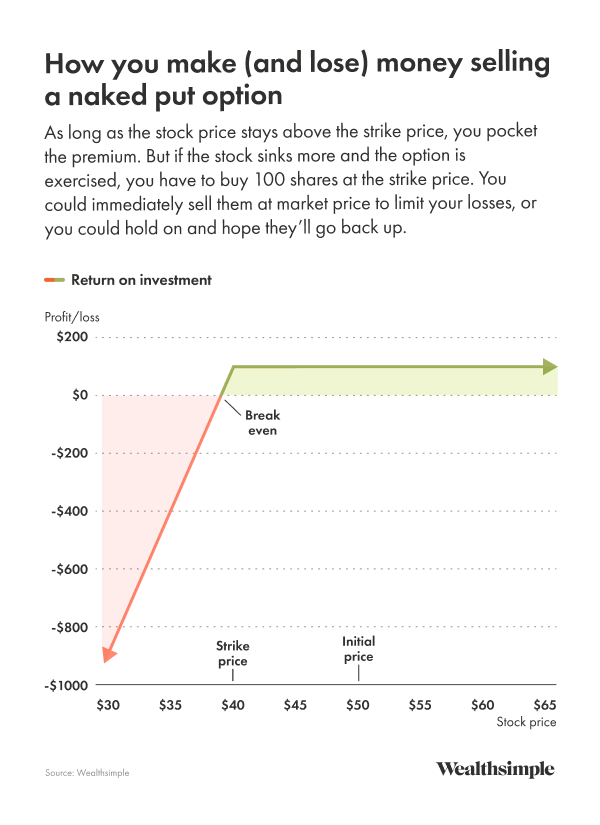
Let's go back to the $PEAR example. Say it's trading at $50 per share. You're bullish on the near term outlook, so you decide to sell a put option of 100 shares, at a strike price at $40, with an expiry date of 30 days from now. You make a premium of $1 per share, or $100 total ($1 x 100). When the expiry date rolls around, here's a few ways it could go down (before any fees and commissions):
The stock price stays above $40: The put option you sold expires worthless because $PEAR shares are now more than the strike price of $40. You walk away with the $100 premium you made for selling the put option.
The stock price drops below $40: The share price is now lower than the strike price, so your buyer exercises their right to sell you the 100 shares at $40 per share, or $4,000 total. You have the profit of $100 from your premium but that's not going to cover it, so you've taken a loss.
If you still actually like $PEAR and think its price will rise again, you might not mind holding the stock for a while. But if you don't, then you can sell your shares at the current market price and lose the difference. With naked put options, losses can be significant, depending on how far the share price falls.
How to buy and sell put options
You can access put options through many online brokerages and trading platforms. You can buy options in different account types, both non-registered, including a margin account and registered accounts, like Registered Retirement Savings Plan (RRSP), Tax-Free Savings Account (TFSA), and First Home Savings Account (FHSA).
Because options trading is considered to be a bit riskier) than many other types of investing, some brokerages require an application before you can get started. Depending on the platform, you may need to meet certain requirements around liquidity (your available cash), trading experience, and trading objectives.
Once you're ready to buy or sell put options, you can choose the parameters of the put option, including:
Strike price
Expiry date
Number of contracts (the quantity of put options available to buy or sell; each contract represents a standardized number of shares of the stock)
Risks of put options
Options trading can offer big gains — and big losses. There's no guarantee of returns.
When you're buying a put option, the downside is limited: you can only lose what you paid in premiums.
But if you are selling a put option, and the stock price falls below the strike price in your contract, you'll have to purchase the stock at the strike price, whatever it is. The further the stock price drops below the strike price, the more money you lose.