Open a non-registered account
Invest without worrying about the limitations of a registered account.


Already maxed out your RRSP and TFSA? A non-registered account is a great place to put your extra savings, with full flexibility.
Key features of a non-registered account
With no minimums, contribution limits, or carry-over rules, you get to decide how much you’d like to invest. But bear in mind, you’ll need to pay taxes on your growth.
4 million Canadians save, grow, and trade here. You’re invited to join them — open a non-registered account today.

Non-registered, TFSA or RRSP: Which account is right for me?
| Non-registered account | RRSP | TFSA | |
|---|---|---|---|
| Helps you save for | Short- or long-term goals — it’s up to you | Retirement | Big purchases or retirement |
| Eligibility | 18 or older | 18–71 years old | 18 or older |
| Annual contribution limit | None | 18% of prior year's earned income, up to $33,810 for 2026 | $7,000 for 2026 |
| Tax impact on contributions | None, but growth on contributions is taxable | Deducted from taxable income | None |
| Tax impact on withdrawals | None | Taxed as income (with some exceptions) | Growth and withdrawals are tax-free |
| Contribution deadline | None | 60 days after December 31st | December 31st, but can carry forward |
| Government benefits | None | Withdrawals may impact other government benefits based on income | No impact on other benefits |
| Withdrawal stipulations | None | Must withdraw to RIF at 71 | None |
| Open a non-registered account | Learn about RRSPs | Learn about TFSAs |
How to use your non-registered account
With Managed investing, we do the heavy lifting. Tell us your goals and timeline and we’ll invest your money in a diverse range of assets.
A non-registered account has more flexibility than most other investing accounts. The amount of money you can add or take out is completely
Transfer your non-registered account to Wealthsimple. It’s easy, painless, and often, we’ll cover any transfer fees.
UI displaying a seamless transfer flow from another financial institution.
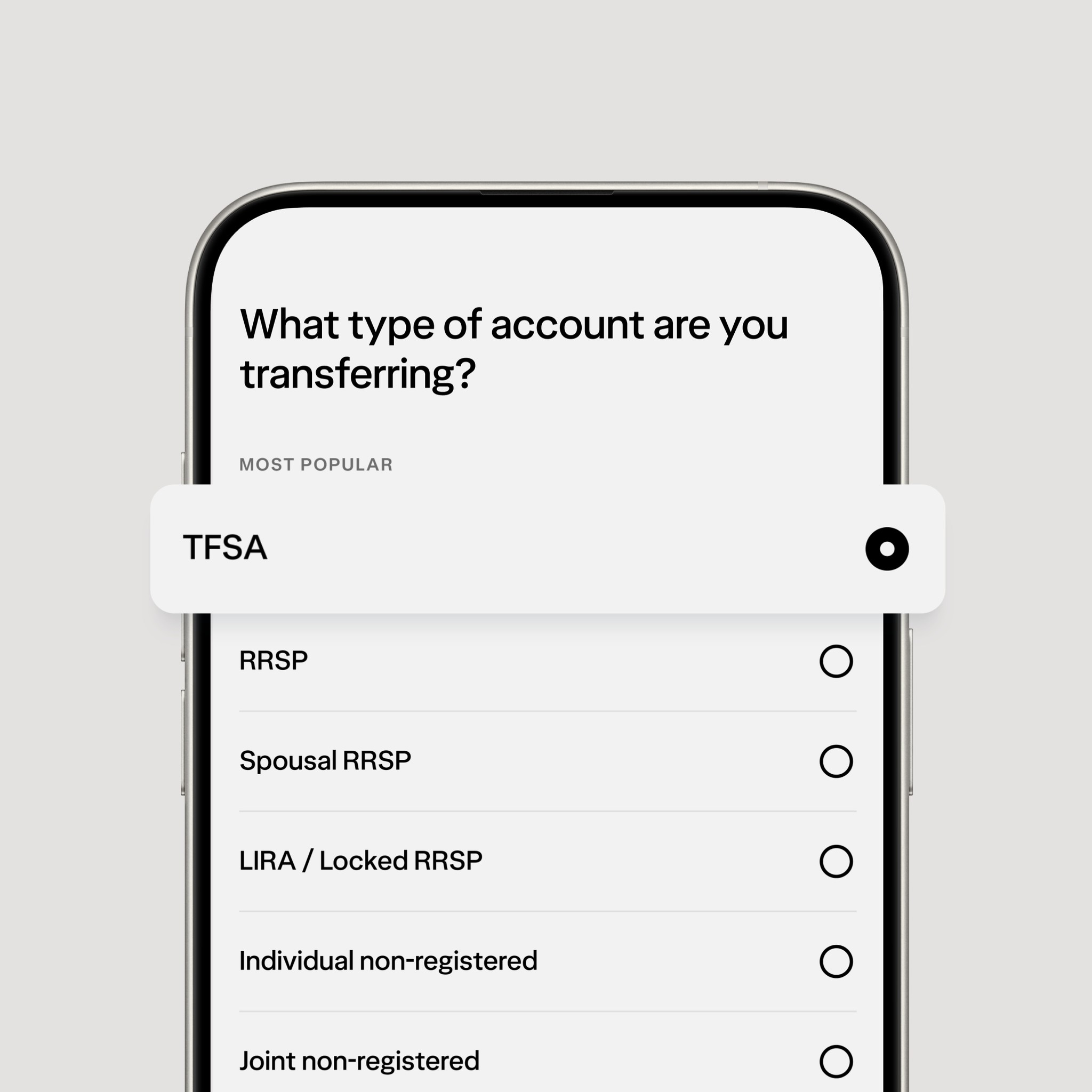
No paperwork. No branches. Start in minutes.
FAQs
How does a non-registered account work?
How does a non-registered account work?
A non-registered account is simply an investment account that isn't sheltered by the government like an RRSP, a TFSA, an FHSA, or an RESP. You can hold stocks, bonds, ETFs, mutual funds, GICs, and cash in one, but unlike registered accounts, everything that happens inside it has tax consequences every year.
What investment can I hold in a non-registered account?
What investment can I hold in a non-registered account?
Similar to a registered account, if you open yours with Wealthsimple you can hold cash, stocks, and ETFs, but remember you will be taxed on your investment growth with a non-registered account.
Are there different ways I can invest using a non-registered account?
Are there different ways I can invest using a non-registered account?
Yes, and that flexibility is a major perk. Here are 2 ways you can use a non-registered account to reach your goals, whatever they may be:
- With Managed investing, we do the heavy lifting. Tell us your goals and timeline and we’ll invest your money in a diverse range of assets.
- Independently trade stocks and ETFs with a Wealthsimple Trade account, which allows you to buy and sell over 14,000 stocks and ETFs commission-free. You can automate your investments, and start trading right away with up to $250,000 in instant deposits.
How do I transfer an existing non-registered account to Wealthsimple?
How do I transfer an existing non-registered account to Wealthsimple?
Hey, great idea. You can transfer your non-registered account to Wealthsimple by following these easy steps. Better yet, if you move more than $25,000, we’ll cover your transfer fees. Conditions apply.
Who should open a non-registered account?
Who should open a non-registered account?
Non-registered accounts are a great option if you’ve already maxed out your TFSA or RRSP and want to continue saving and investing further. But remember, while non-registered accounts offer a ton of flexibility without many limits, you’ll need to pay taxes on your growth.
You can open an account on your own, or join forces with a spouse or common-law partner and open a joint account.
Depending on your financial situation, a TFSA or RRSP might be more beneficial.