How much money you need to retire depends on a lot of things, but the biggest is you. One person might want a big suburban home that all the grandkids can visit, while another is happier in a tiny house with a half-fridge and a bed they can't sit up in without bumping their head. The good news is there are two easy(ish) ways to calculate how much you'll need to get there, and it works for both types of people — and everyone in between.
One quick way to estimate your retirement savings target is to use a widely available artificial intelligence (AI) tool. Here's a sample prompt you can use with an AI tool to get an initial estimate: "I'm a ____-year-old Canadian with a current household income of _____ and current savings of _____. Please calculate how much I need to save for retirement, including my estimated Old Age Security (OAS) and Canada Pension Plan (CPP) payments and accounting for inflation." (Tip: include details like your age, income, savings, and target retirement age so the estimate is more useful.)
On the off chance that you're not ready to have a digital helper, here's how to handle the calculation on your own.
Step 1: Estimate your yearly retirement spending
Most Canadians will need about 70% of their current income to maintain their lifestyle in retirement. If you make $65,000 a year now, that means you'll need roughly $45,500 per year once you retire.
This rule of thumb works because many of your current expenses will disappear — like mortgage payments, life insurance, saving for your kids' education, and putting money aside for retirement.
Step 2: Subtract government benefits
The government provides three income sources that reduce how much you personally need to save:
Canada Pension Plan (CPP): A monthly benefit based on your contributions during your working years. If you've worked in Canada, you likely contributed 5.95% of earnings up to $68,500 each year. Use the CPP calculator to estimate your benefit.
Old Age Security (OAS): A monthly benefit for eligible seniors, generally starting at age 65, based on how long you've lived in Canada.Note that OAS may be reduced (clawed back) if your retirement income exceeds certain thresholds.
Guaranteed Income Supplement (GIS): Depending on eligibility, GIS can provide up to about $1,000 per month for lower-income seniors. Eligibility depends on your marital status and previous year's income.
Step 3: Add workplace pensions and other income
According to Statistics Canada, a little under 40% of Canadian workers are members of some sort of workplace pension plan. That's 6.7 million people who have reliable pension income coming their way in retirement.
Exactly how much will depend on how long you paid into the plan and how it has performed. Ask your employer for an estimate to help you with planning.
Step 4: Turn annual spending into a savings target
Multiply your annual retirement spending need by 25. This is based on the 4% rule, a guideline suggesting that withdrawing about 4% of a diversified portfolio per year has historically been more likely to last roughly 30 years, depending on market conditions.
You now have a rough savings target for retirement. Next, adjust it for inflation and your specific circumstances.
Step 5: Adjust your number for inflation
Your calculation so far is in today's dollars. You need to adjust that number to account for all the years of inflation between now and your last day in the office.
To get your inflation-updated number, multiply the number you calculated above by 1.02^n, where n is the number of years before you plan on retiring. If you'd like to leave a gift to family members or a charity in your absence, add that amount to your total.
When should you start saving for retirement?
Start as soon as you can. Thanks to compound interest, the money you invest in your 20s and 30s has more time to grow, which can reduce how much you need to contribute later, depending on returns and your goals.
If you're getting a late start, don't panic. Many Canadians hit their peak earning years in their 40s and 50s, which makes it an effective time to aggressively catch up on contributions.
How much should you save each month?
Once you have a retirement target, use a reverse retirement savings calculator to estimate how much to contribute each month.
As a general guideline, aim to save 10% to 15% of your pre-tax income for retirement. If that feels impossible right now, start with $50 a month and increase it every time you get a raise.
Where to save for retirement in Canada
Canada offers two main tax-advantaged retirement accounts:
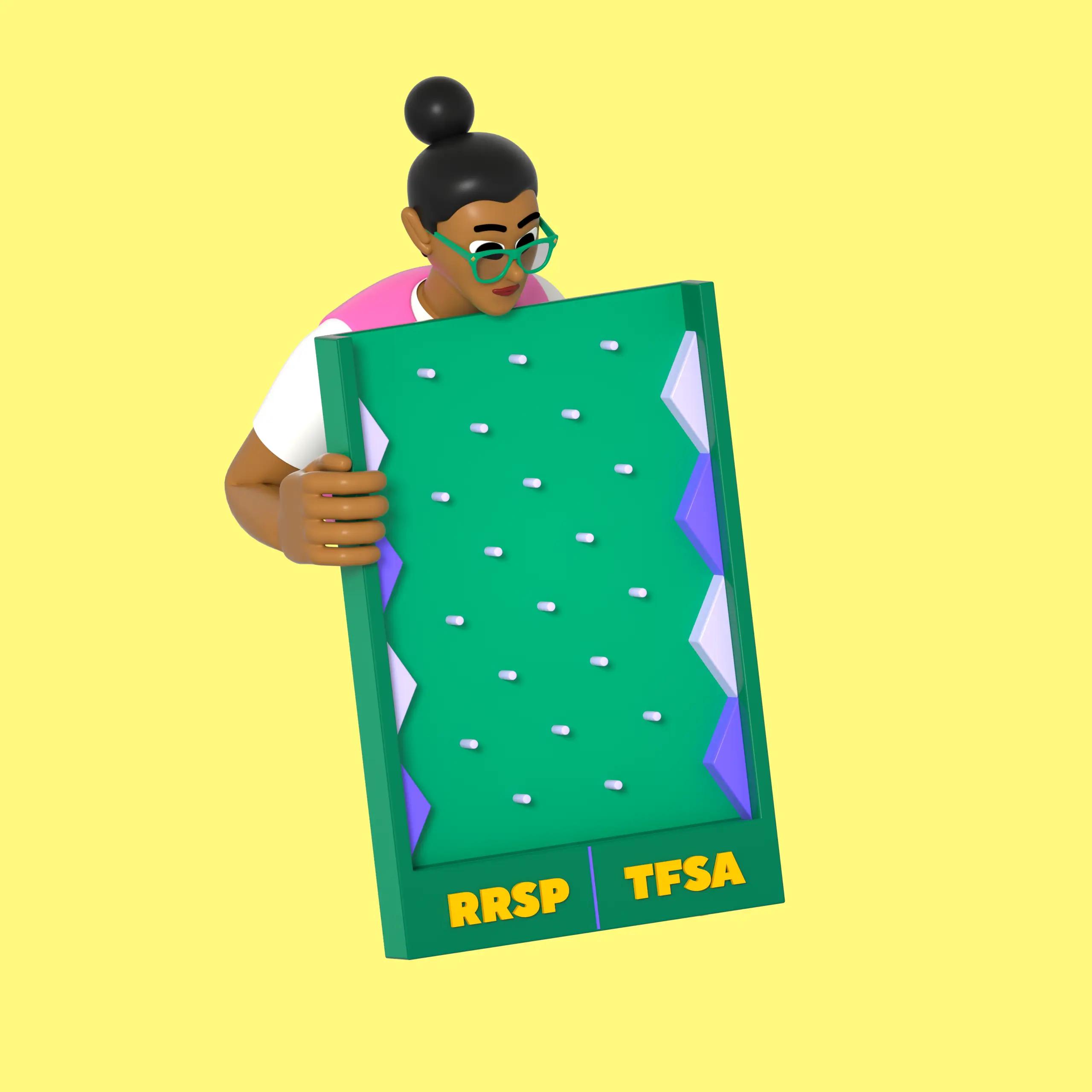
Registered Retirement Savings Plan (RRSP): Contributions reduce your taxable income now (hello, tax refund), but you'll pay tax when you withdraw in retirement. Works well if you expect to be in a lower tax bracket later.
Tax-Free Savings Account (TFSA): No immediate tax break, but your investments grow tax-free and withdrawals are completely tax-free. Works well if you expect similar or higher income in retirement.
Most Canadians benefit from using both accounts. The right mix depends on your current income, expected retirement income, and available contribution room.
How to invest your retirement savings
You don't need to be a stock-picking genius. A globally diversified portfolio of exchange-traded funds (ETFs) can spread your money across thousands of companies, reducing risk while you grow your savings.
Key principles:
Diversify broadly: Don't concentrate your investments in a single asset or sector.
Keep fees low: High fees can reduce long-term returns.
Stay invested: A consistent, long-term approach often outperforms frequent market timing.
As retirement approaches, gradually shift from stocks to bonds to protect what you've built.
How to start saving today
Three steps to get started:
Automate contributions: Set up automatic transfers from your paycheque into your Registered Retirement Savings Plan (RRSP) or Tax-Free Savings Account (TFSA) before you spend it.
Use employer matching: If your employer offers matching contributions, contribute enough to receive the full match.
Review annually: Check your progress once a year and increase contributions when you get a raise.