Choosing a city in Canada means weighing housing costs, career opportunities, climate, and lifestyle — here's what to consider and how major cities compare on affordability.
What if you could live anywhere in Canada — where would you go? It's a question more Canadians are asking as remote work, rising housing costs, and shifting priorities make relocation a real option. There's no single answer — a city that's perfect for a remote worker earning a Toronto salary looks very different from the right choice for a young family on a single income. This guide walks through the key factors to consider, how major cities compare on affordability, and a practical process for narrowing down your options.
Why more Canadians are rethinking where they live
For most people, this question has an easy answer: if you currently live in Ottawa and you want to stay in Ottawa, you house-hunt in ... Ottawa.
But what if you're a remote worker and, even though your employer is in Winnipeg, you can live somewhere with sunlight and an occasional hill? Or you've lived in Halifax all your life but hate the smell of the ocean. How do you decide where to look?
As home prices in major urban centres continue to rise sharply, a lot of Canadians are becoming increasingly open to less-expensive areas. According to a survey by Canadian real estate company Royal LePage, 60% of big-city renters said they'd consider a move to a smaller city. 29% of Greater Toronto Area (GTA) residents said they'd leave for Québec City under the right circumstances, and 19% of Vancouver renters said they'd consider Edmonton.
Key factors to consider when choosing a city
Cost of living and housing affordability
Housing is usually the single largest line item in any budget, and in Canada, the gap between cities is enormous. The average home price in Vancouver or Toronto can easily exceed $1 million, while cities like Winnipeg, Regina, and Saint John offer homes for a fraction of that. But sticker price isn't everything — property taxes, utilities, groceries, and transit costs vary widely too.
Rent tells a similar story. A one-bedroom apartment in downtown Toronto might run you $2,500 a month, while the same apartment in Québec City or Moncton could cost less than half that. If you're trying to build savings or pay down debt, the city you choose has a direct impact on how quickly you get there. If you're planning to buy, figuring out how much mortgage you can afford is a natural next step.
Employment and career opportunities
If your job isn't remote, the local labour market matters — a lot. Toronto, Vancouver, and Montreal still dominate in sectors like finance, tech, and media. Smaller cities have carved out specialties too: Waterloo is a tech hub, Halifax has a growing ocean-technology sector, and Calgary's energy industry continues to drive hiring.
It's worth thinking about what happens if you lose your job or want to switch careers. A city with a diverse economy gives you more options than a one-industry town.
Safety and community
Crime rates, walkability, access to healthcare, and the general feel of a neighbourhood all factor into quality of life. Statistics Canada publishes annual crime severity index data for every municipality, which is a useful starting point. Spending time in a city before committing to it gives you a much better sense of whether you'd actually enjoy living there.
Community matters too. If you have kids, you'll want to look at school quality and proximity to parks. If you're moving somewhere where you don't know anyone, look for cities with active community groups and social infrastructure that helps newcomers connect.
Climate and lifestyle
Canada's climate varies wildly from coast to coast to coast. Victoria rarely dips below freezing; Winnipeg can hit −40. If you love skiing, the Rockies or Laurentians put you within reach of major ski resorts. If you want a long cycling season, southern Ontario or coastal B.C. might make more sense.
Don't underestimate how much weather affects your day-to-day happiness. A gorgeous, affordable city where you're miserable 5 months of the year isn't actually a great deal.
How remote work changes the equation
This trend isn't just a cost consideration, though. People like being closer to nature — and escape. "People just didn't even consider it an option before," says Royal LePage chief operating officer Karen Yolevski. But now, the post-pandemic rise of remote work has put smaller cities on the table. "As Canada grows and our population expands rapidly, there's going to be more people that say, 'This is too much, the traffic is too much, the subway breaking down is too much.'"
Remote work has fundamentally reshuffled the deck. When your office is your laptop, the old calculus — live close to work, pay a premium for a short commute — stops making sense. A growing number of Canadians are realising they can keep their Toronto salary while living in a city where their dollar stretches dramatically further.
The trade-off? You might need to fly in for the occasional meeting, and your social life may take a bit more effort to build from scratch. But for many people, the math works out overwhelmingly in their favour.
Why bigger isn't always better
If you're trying to get the most value for your money, Yolevski says, there's one factor that buyers too often over-prioritize: size. "People are still very, very keen on big homes, lots of land. But bigger homes are more expensive to buy, more expensive to maintain. They're not as easy to just lock up and go on a vacation from." Yes, she's saying size doesn't matter — or at least not as much as you might assume. It might be worth sacrificing some square footage for a happier, more satisfying life beyond your front door.
This is especially true in smaller cities, where your money typically gets you more than square metres — it gets you proximity. That translates to a shorter commute, a walkable neighbourhood, and access to green space — things that compound over time in ways an extra bedroom simply doesn't.
How Canadian cities compare on affordability
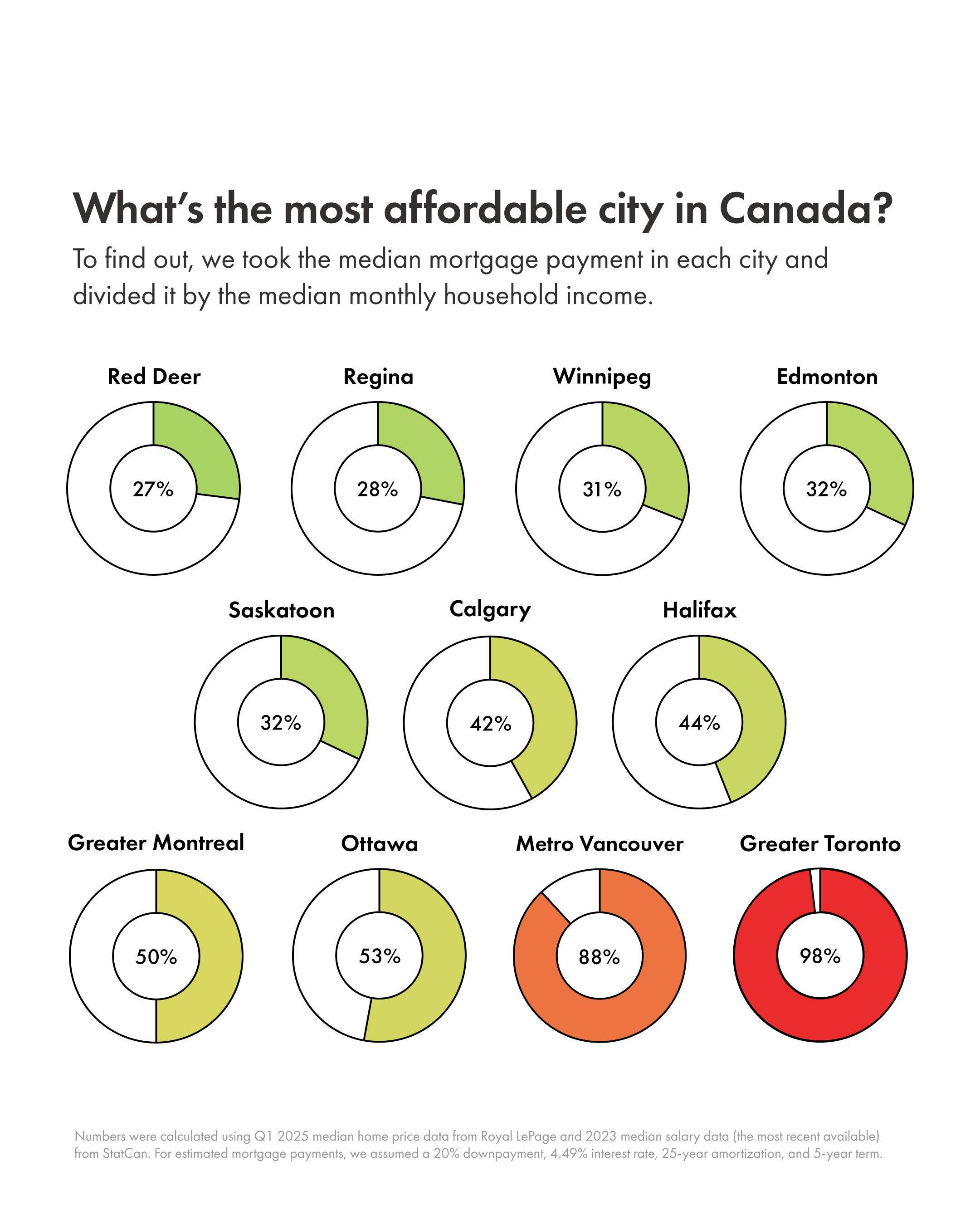
Affordability is relative, but here's a rough snapshot of how a few cities stack up. Treat these as a general guide rather than a fixed ranking — the market shifts constantly.
Higher cost. Vancouver and Toronto consistently top the list, with average home prices well above $1 million and rents to match.
Mid-range. Ottawa, Calgary, and Montreal sit in the middle — housing is still cheaper than the big two, job markets are strong and amenities are solid.
More affordable. Winnipeg, Edmonton, Regina, Québec City, Moncton, and Saint John offer much lower housing costs. The trade-offs vary — some have harsher winters, some have fewer cultural amenities — but the savings are real.
Rising markets to watch. Halifax, Kelowna, and cities in the Niagara region have seen prices climb as remote workers and retirees move in. They're still more affordable than Toronto or Vancouver, but the gap is narrowing.
Provincial tax rates, healthcare coverage nuances, and childcare subsidies differ too — so the true cost of living in any city depends on more than housing alone.
How to narrow down your options
There's no formula that spits out the right city for you, but there is a process that helps. Start by listing your non-negotiables — the things you genuinely can't compromise on. Maybe it's proximity to family, a certain income level, or access to an airport.
Then rank your nice-to-haves: walkability, nightlife, outdoor recreation, school quality, and cultural diversity. Once you've got a short list, do the homework — look at actual rental and housing listings, not averages. Check commute times for the neighbourhoods you'd realistically live in.
And if you can, spend a week or two in your top choices before making a decision. A city that looks perfect on a spreadsheet might feel completely different on the ground. The goal isn't to find the objectively "right" city — it's to find the one where your money, your career, and your daily life come together in a way that makes you genuinely glad you moved.