If you're like a lot of people, you find budgets intimidating. Who wants to track every penny in a spreadsheet? Who wants to give up their favourite luxuries?
In order to be financially responsible, we have to track our spending somehow. If you want to retire someday, you have to take a hard look at how you spend your money.
Does that mean you have to give up your morning coffee or break your addiction to scented candles? Not necessarily. You can spend some fun money, but there has to be a limit.
What does the 50/30/20 rule mean?
The 50/30/20 rule is a budgeting method that divides your after-tax income into three categories: 50% for needs, 30% for wants, and 20% for savings and debt repayment. It was popularized by U.S. bankruptcy expert Senator Elizabeth Warren and her daughter, Amelia Warren Tyagi.
Here's how it breaks down:
50% — needs: housing expenses, food, transportation, and child care
30% — wants: travel, restaurants, entertainment, and luxury products
20% — financial goals: debt reduction, cash savings, and investments
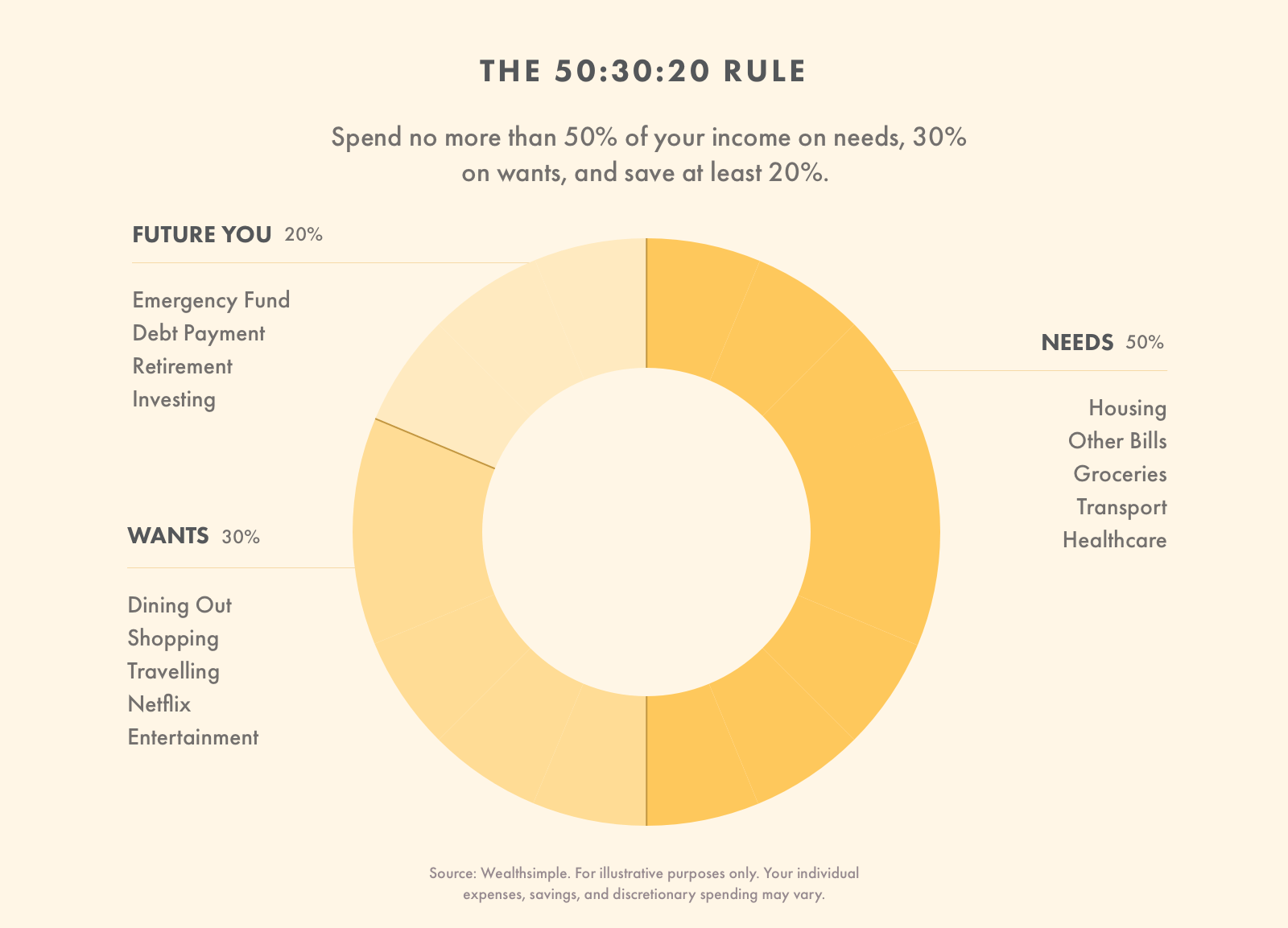
You don’t have to adhere to those percentages exactly (because real life is messy), but you should use them as guidelines. The 50/30/20 percentages often bend under the real pressures associated with the cost of living in major cities. While they can bend, they should not break.
Why does the 50/30/20 rule work?
The 50/30/20 rule works because it's simple. You don't need complex spreadsheets or tools, which means you're more likely to follow it. It's a practical starting point for people who are new to budgeting.
This budget gives you some flexibility. For example, if you live in a high-cost-of-living area, you may need to spend 55% of your income on needs and reduce your wants to 25%.
It's smart to treat your needs and wants as limits and your savings as a target. If your needs cost more than 50%, find ways to reduce them. If your wants cost more than 30%, spend less.
If you save more than 20% — great! There's no limit to how much you can save. If you have substantial debt, consider shifting some of your wants to your savings to reduce that burden and save on interest fees.
Pros and cons of the 50/30/20 rule
Like any budgeting approach, the 50/30/20 rule has strengths and limitations. Here's a quick look at both sides.
Pros:
Simple to follow — you're working with three broad categories instead of dozens of line items
Flexible enough to adjust percentages when your circumstances change
Prioritizes savings by building it into the framework from the start
No special tools required — a calculator and your pay stub are all you need
Cons:
May not suit high-cost cities like Toronto or Vancouver, where housing alone can exceed 50% of income
Doesn't account for irregular income, which makes percentage-based splits harder to apply
Oversimplifies debt — someone carrying significant student loans or credit card balances may need a more aggressive repayment plan
One size doesn't fit all life stages — a new graduate, a growing family, and a pre-retiree have very different financial pressures
How to budget using the 50/30/20 rule
To budget using the 50/30/20 rule, first calculate your after-tax income. Plan to spend 50% on needs, 30% on wants, and 20% on savings and paying down debt.
Step 1: Calculate your after-tax income
Your after-tax income is what's left over after your employer deducts your taxes, Canada Pension Plan (CPP), and Employment Insurance (EI) costs. You can find this total on your pay stub. If your employer deducts retirement contributions, add those back — those expenses belong in the needs category.
If you're self-employed, your after-tax income includes your gross income minus business expenses and what you set aside for taxes. Hopefully you're making those quarterly payments!
If you mingle your finances with a partner, add your after-tax income together to design a budget for your household.
Step 2: Limit your needs to 50% of your income
Your first step is to reduce your expenses so your needs are less than 50% of your after-tax income. Your needs are expenses you have to pay, which include:
Rent or mortgage payments
Auto loans and transportation costs
Insurance premiums
Food and household supplies
Utility bills
Cell phone bills
Essential clothing and shoes
Minimum credit payments
You'll have to use some discretion to separate your needs and wants, but it's wise to stick to a strict definition of needs. It should include things you can't live without.
Step 3: Limit your wants to 30% of your income
Your next step is to reduce your spending on wants. Wants are expenses you could forgo without affecting your quality of life. They include convenience and luxury items, or items you could acquire through cheaper means.
Here are some examples:
Cable and internet bills
Luxury clothing and shoes
Restaurants and take-out meals
Travel and holidays
Upgraded phone plans
Spa, nail, and personal care
Gadgets and toys
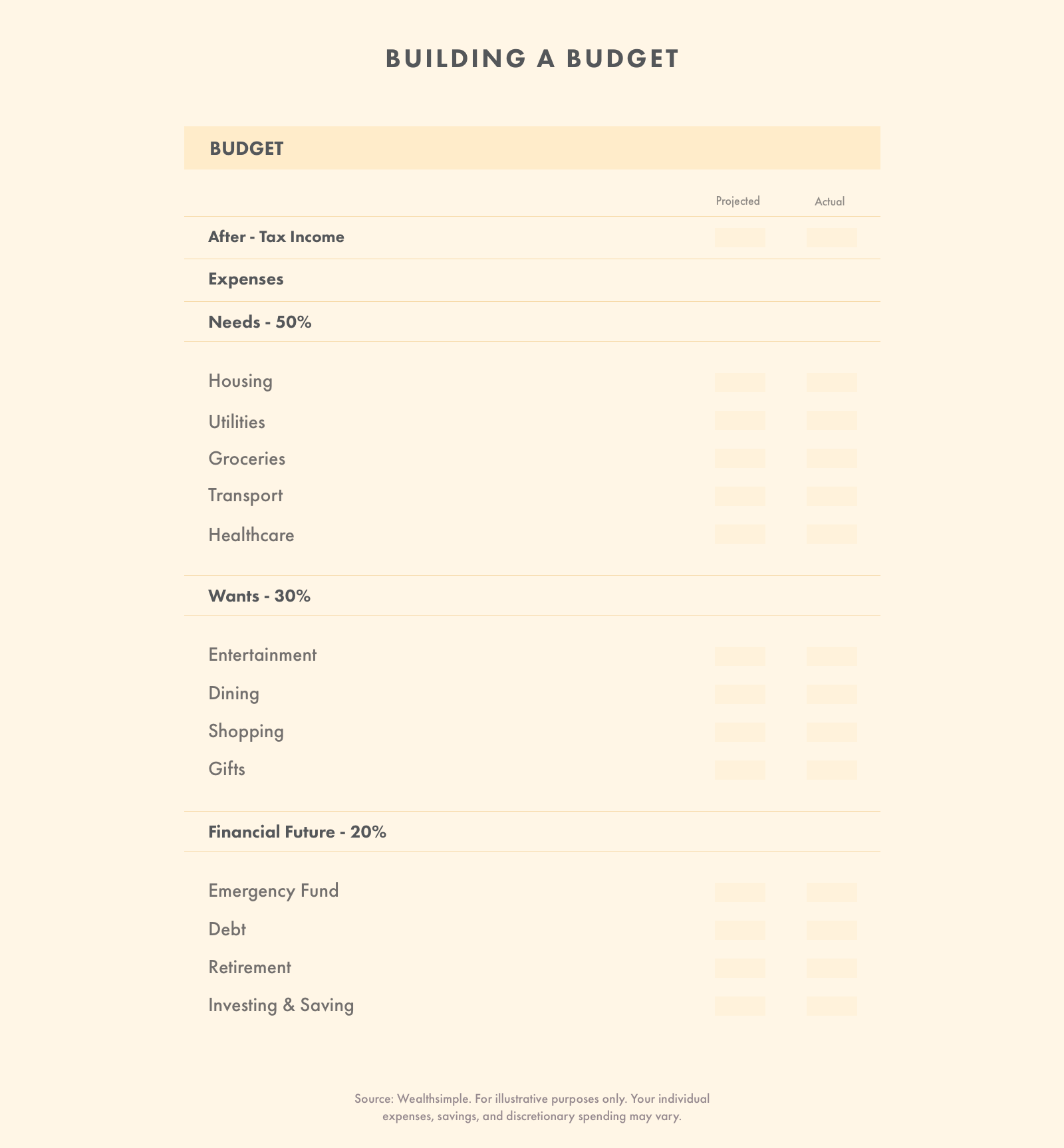
You may be thinking, "Wow, I can spend 30% of my income on the things I want!"
That's not entirely accurate. Since we're using a strict definition of need in the previous category, more of the things you buy every day fall into your want column than you think.
For instance, you might include coffee beans in your need category, but coffee runs every morning certainly wouldn't. The unlimited data plan, gym membership, and lobster tail don't count either, even though you could make an argument that they fill a need to some extent.
Step 4: Allocate 20% of your income to debt and savings
The final portion of your after-tax income goes toward paying down debt, cash savings, and investing. Since your minimum debt payments are handled in the needs category, it's important to build an emergency fund as quickly as possible.
Keep cash on hand until you have 3 to 6 months' worth of expenses covered.
Once you've established an emergency fund, use this 20% of your income to whittle down your debt obligations. Credit card debt is especially important to eliminate quickly, but you may have personal loans as well.
Once your debt is gone (mortgages and car loans notwithstanding), resist the urge to spend this 20% on more wants. Continue saving in a low-risk investment savings account or a diversified investment account.
Step 5: Stick to it
The most important part of any budget is to stick to it. You can't realize the value of a budget if you don't abide by its rules.
An easy way to stick to a budget is to separate your money the moment you earn it. Once you receive your paycheque, use it to immediately pay your needs (the 50% portion of your income) and your savings (the 20% of your income). What's left is for your wants, but of course you don't have to spend it all.
Sample 50/30/20 budget
Let's say your household of four earns $5,000 each month. According to the 50/30/20 rule, you can spend $2,500 on your monthly needs and $1,500 on your wants. Use the remaining $1,000 each month to pay down debt or save.
This means that a $2,000 rent or mortgage payment isn't affordable, especially if you have to pay for other needs like your car, utility, and cell phone bills. Your family probably wants to eat each month too!
If your needs exceed 50% of your income, it's fine to shift some of the cash from your wants column, but temporarily. Take steps to reduce your needs to fit into the 50% category.
You might relocate to a less expensive living situation, get a car that uses less fuel, or transfer credit card debt to 0% interest cards. The 50/30/20 rule is a practical plan for people who don't want to budget, but the key is to stay consistent. Each month you spend responsibly will give you freedom to enjoy yourself later in life.
Alternatives to the 50/30/20 rule
The 50/30/20 rule isn't the right fit for everyone. If you need something more tailored, here are a few other budgeting methods worth exploring.
The 80/20 rule
This approach simplifies things further: save 20% of your after-tax income and spend the remaining 80% however you like. It removes the need to sort expenses into "needs" and "wants," which makes it a practical option if you find detailed categorisation frustrating.
The envelope system
With the envelope system, you divide your cash into physical or digital envelopes for each spending category — groceries, dining out, entertainment, and so on. When an envelope is empty, you stop spending in that category. It's a hands-on method that can help you build awareness of where your money goes.
Pay-yourself-first budgeting
This method flips the script. Instead of budgeting what's left after expenses, you set aside your savings first — as soon as your paycheque arrives — and spend the rest. It can work well for people who want to prioritize long-term goals without tracking every dollar.
Zero-based budgeting
With zero-based budgeting, every dollar of your income gets assigned a purpose — whether it's rent, groceries, debt repayment, or fun money. At the end of the month, your income minus your expenses equals zero. It takes more effort to set up, but it gives you a complete picture of your finances.