
Don’t want to micromanage a custom portfolio? Bring your strategy, choose your holdings, and we’ll help you keep things on track.
Create your custom portfolio
A view of a user's watchlist, along with a list of options for Direct Indexing.
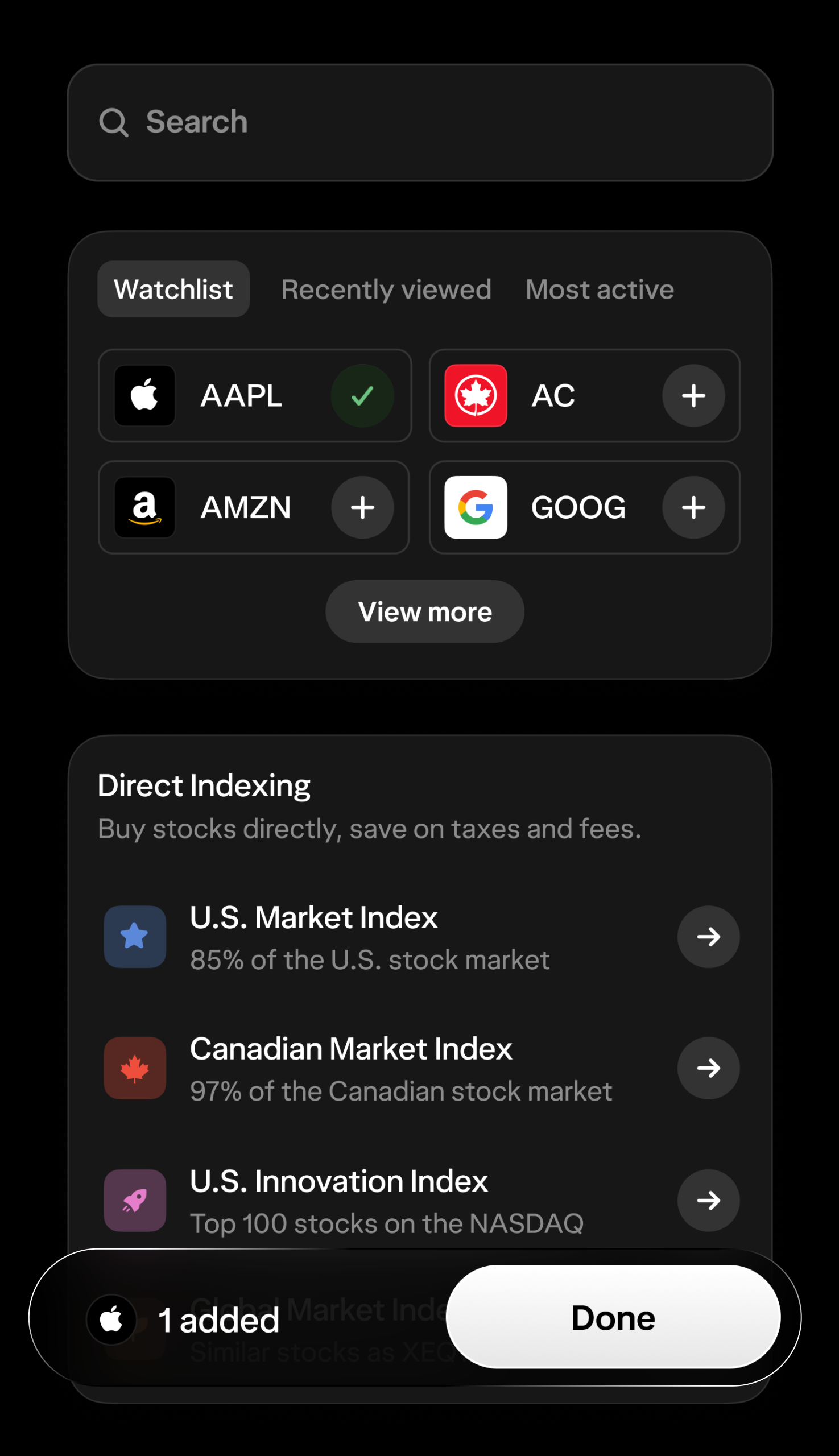
Choose your own blend of stocks, ETFs, and indices — or edit a pre-built portfolio to your liking. Set a target percentage for each asset to create a portfolio uniquely built around your convictions, risk tolerance, and timelines.
Read more
Choose your own blend of stocks, ETFs, and indices — or edit a pre-built portfolio to your liking. Set a target percentage for each asset to create a portfolio uniquely built around your convictions, risk tolerance, and timelines.
A view of a user's watchlist, along with a list of options for Direct Indexing.
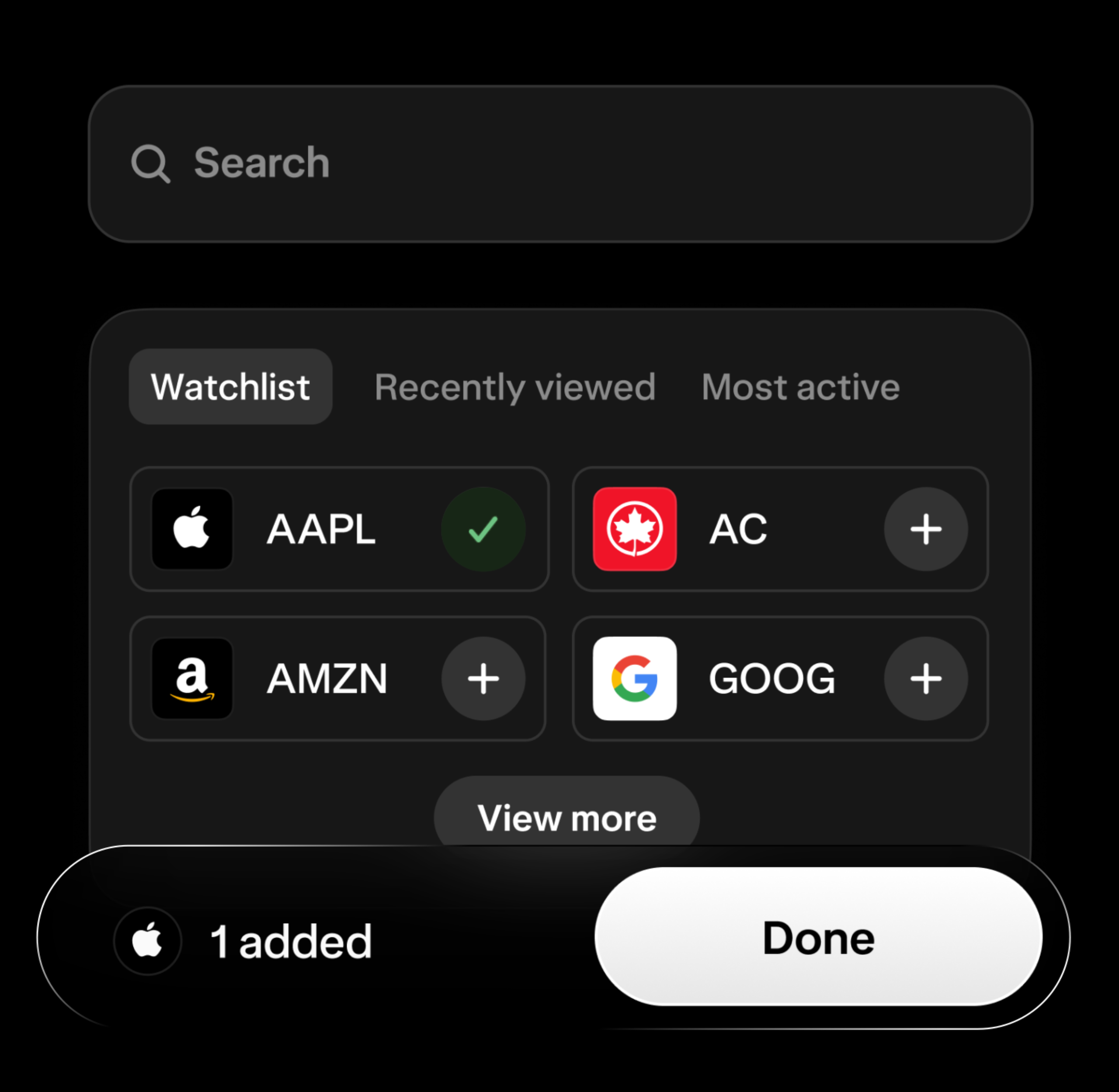
A view of a user's watchlist, along with a list of options for Direct Indexing.
Read more
Choose your own blend of stocks, ETFs, and indices — or edit a pre-built portfolio to your liking. Set a target percentage for each asset to create a portfolio uniquely built around your convictions, risk tolerance, and timelines.
Check if your target percentages are on track
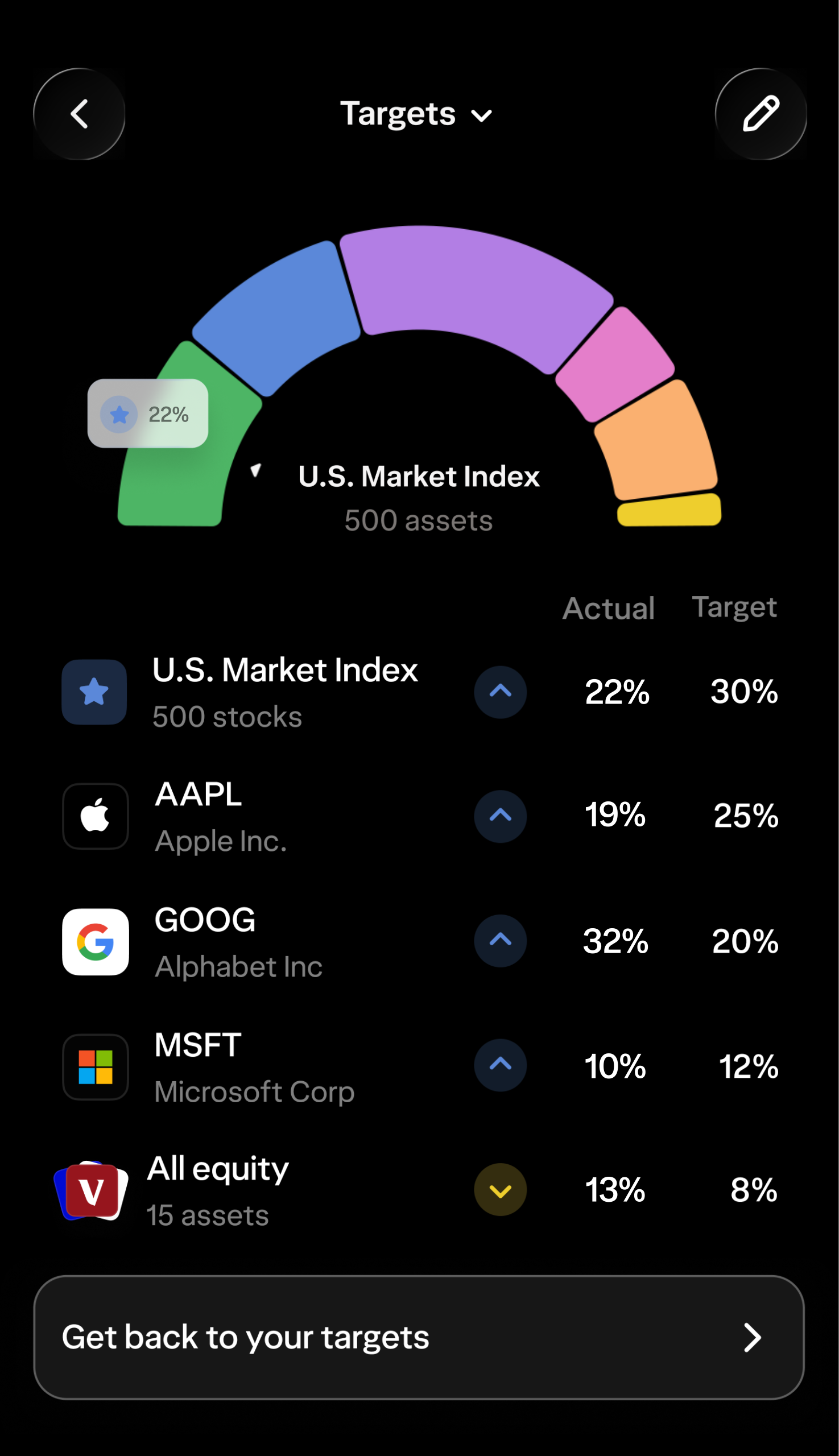
A view of a user's target allocations, along with the stock and indices they're currently invested in.
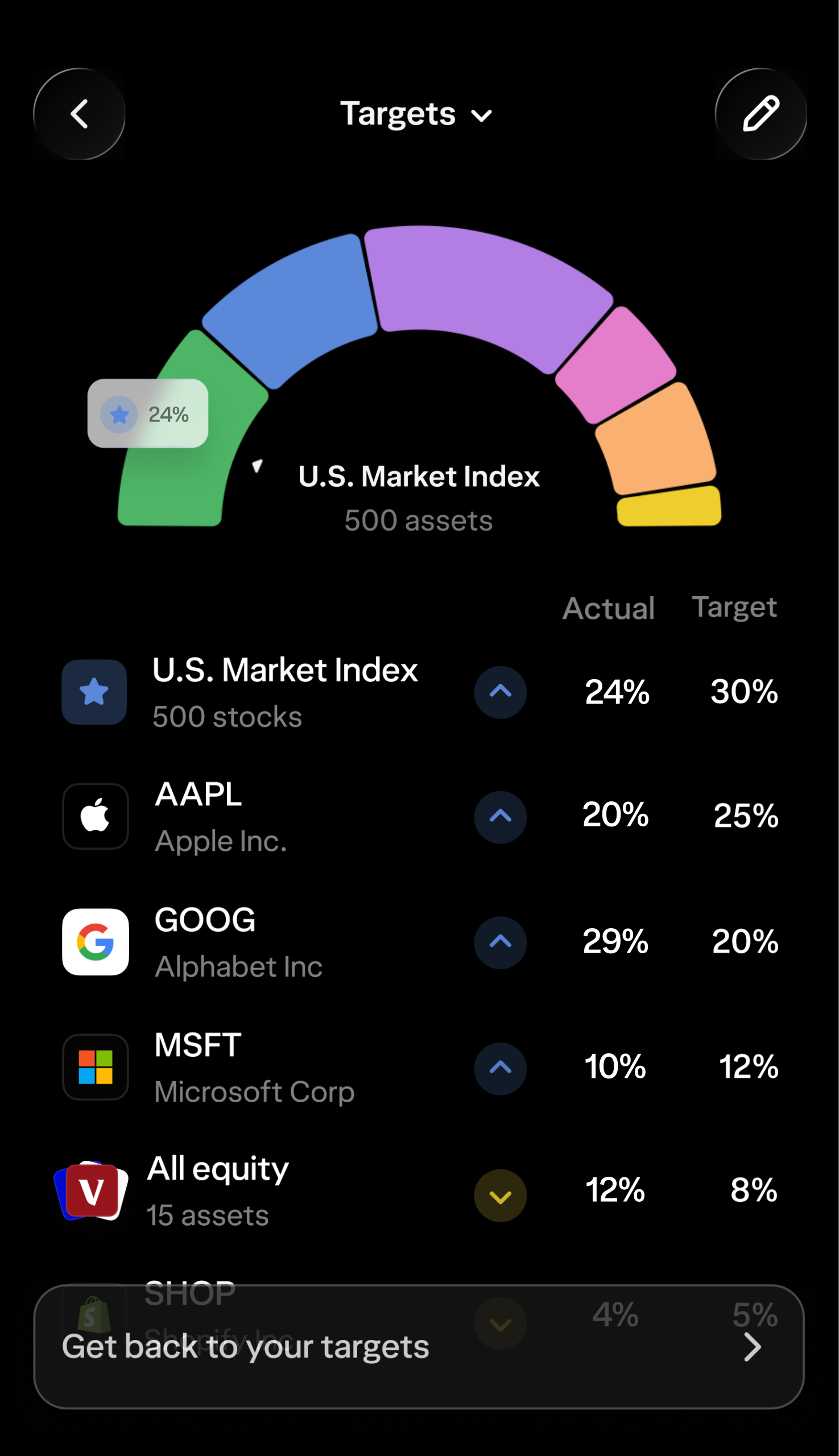
Track each holding’s actual weight compared to your target, and watch the market move. If one asset outpaces another, you’ll see it.
Read more
Track each holding’s actual weight compared to your target, and watch the market move. If one asset outpaces another, you’ll see it.
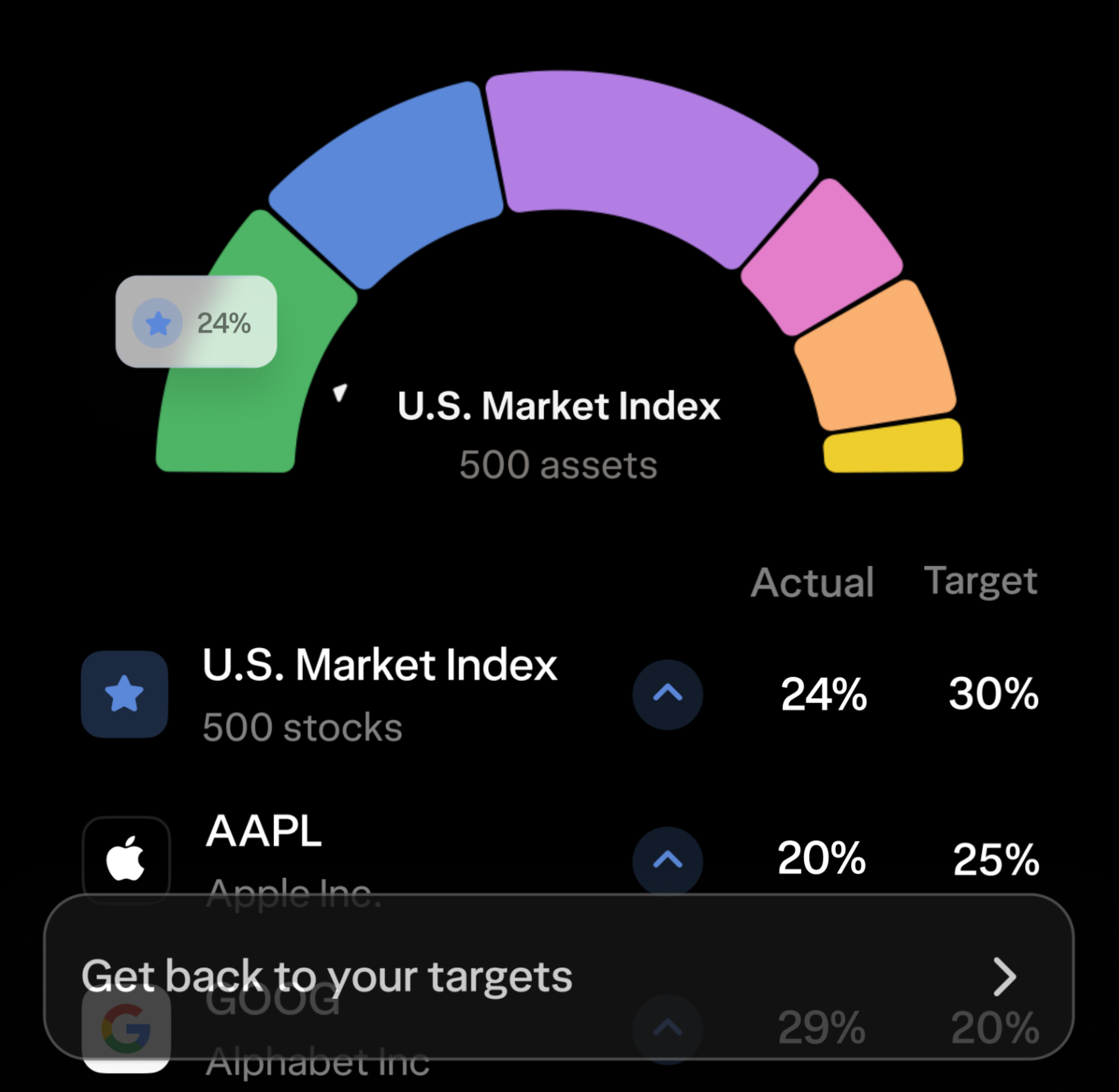
A view of a user's target allocations, along with the stock and indices they're currently invested in.
Read more
Track each holding’s actual weight compared to your target, and watch the market move. If one asset outpaces another, you’ll see it.
Keep your portfolio on track in a few taps
A view of Direct Indexing in action, displaying 500 assets owned in the U.S. market index. Deposits and the amount of tax losses harvested are also displayed.
Notice drift? You have options. Deposit money and we’ll buy what’s underweight, or fully rebalance your portfolio — we’ll buy and sell until every holding is back where you set it.
Read more
Notice drift? You have options. Deposit money and we’ll buy what’s underweight, or fully rebalance your portfolio — we’ll buy and sell until every holding is back where you set it.
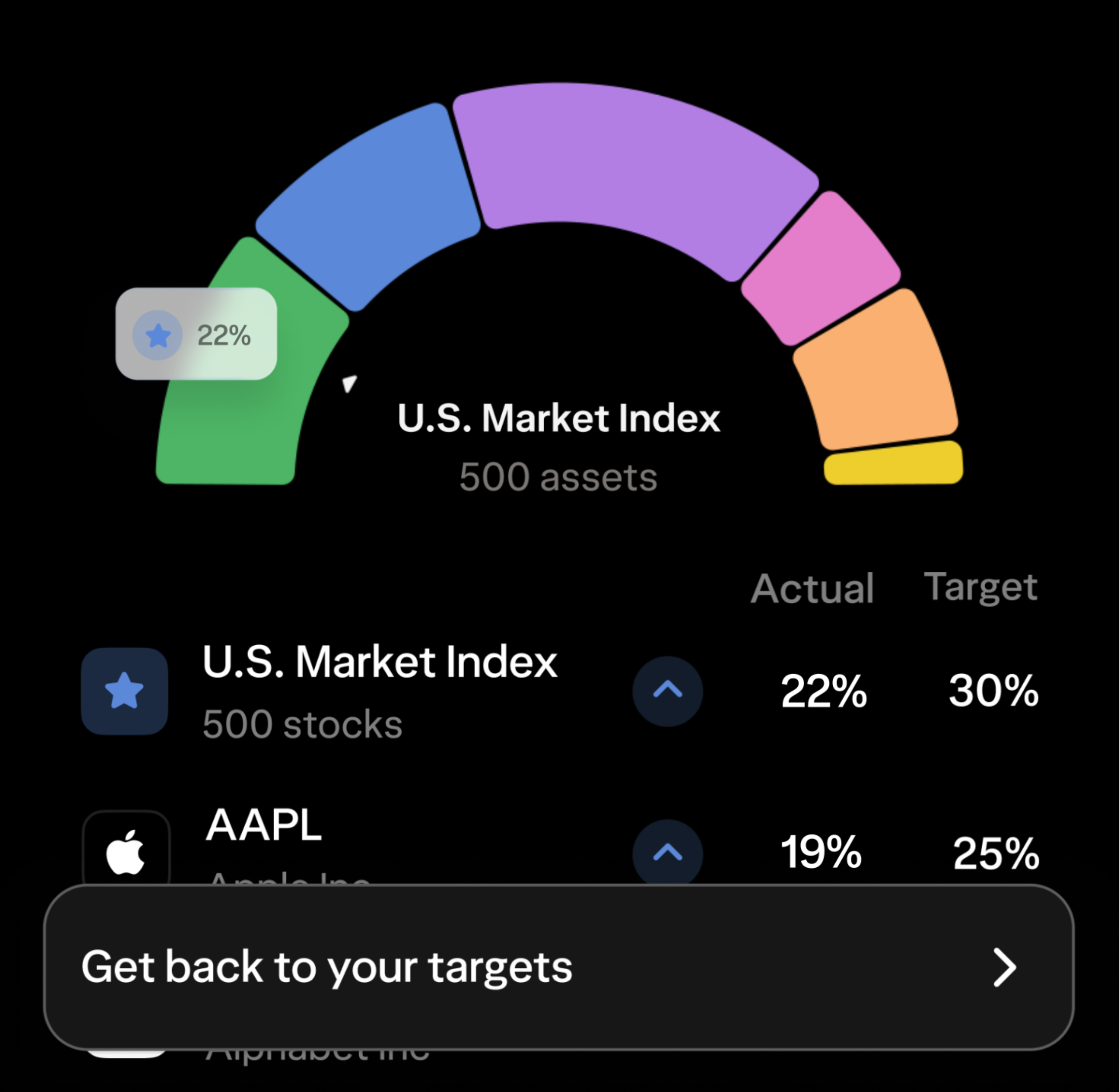
A view of Direct Indexing in action, displaying 500 assets owned in the U.S. market index. Deposits and the amount of tax losses harvested are also displayed.
Read more
Notice drift? You have options. Deposit money and we’ll buy what’s underweight, or fully rebalance your portfolio — we’ll buy and sell until every holding is back where you set it.
Put more money back in your pocket with Automated Investing. Here’s how.
Automated Investing has an annual management fee of 0.25%. But that fee is capped when your balance reaches $100,000, meaning you’ll never pay more than $250 annually per account.
See if Automated Investing is right for you
| Trading | Automated Investing | Portfolio investing | |
|---|---|---|---|
| How it works | Choose your investments, manage them yourself | Choose your investments, we help you manage them | We choose your investments based on your goals, we manage them for you |
| Time needed | As much or as little as you want | Low — we’ll nudge you when action is needed | None — we actively manage things for you |
| Level of control | High — you get full control over everything | Medium — choose your assets, we automate the rest | Low — it’s left to your portfolio manager |
| Rebalancing | Review your portfolio, do the math, execute trades | Get back on track in a tap | We got you covered |
| Fees | $0 commissions | 0.25% of your assets, never more than $250 per year | 0.2% to 0.5% |
Put your conviction on cruise control
FAQs
How do Automated Investing accounts work? Is this different from your managed portfolios?
How do Automated Investing accounts work? Is this different from your managed portfolios?
The TLDR: They’re different products, built for different people. Managed portfolios are pre-built, and tailored to broader financial goals. Automated Investing is built for self-directed investors who have conviction about what they want to own. You maintain full control over your portfolio composition and allocations. Automated Investing provides you rebalancing tools to help keep your portfolio on track, while with managed investing, we make investment decisions on your behalf.
What assets can I add to my Automated Investing portfolio?
What assets can I add to my Automated Investing portfolio?
You can build your Automated Investing portfolio using any combination of individual stocks and ETFs, pre-built collections, and Direct Indexing.
-
Individual stocks and ETFS — You can search for and add any individual stock or ETF available on Wealthsimple and assign it a target percentages in your portfolio. This gives you full flexibility to build a portfolio that reflects your own investment preferences.
-
Collections — Collections are pre-built portfolios based on basic asset allocations (for example, All Equity, Mostly Equity, 60/40 Equity/Bonds, or Mostly Bonds). They're designed as a starting point to help you build a diversified portfolio without having to research every individual holding yourself. After adding a collection, you can customize the individual holdings and their targets to better fit your goals.
-
Direct Indexing — Direct Indexing lets you track a market index by directly owning a subset of the individual stocks that make up that index — rather than holding an ETF. This can help reduce your tax bill over time, and it also enables customization — you can exclude stocks from an index that you don't want to hold.
How does rebalancing work?
How does rebalancing work?
You have two ways to reach your target percentages:
-
Deposit money — we’ll buy holdings that are below their targets, but we won’t sell anything. You might not reach your targets exactly, but you’ll get closer.
-
Buy and sell — otherwise known as rebalancing. We’ll buy and sell holdings until everything matches the targets you’ve set.
I’m interested in Automated Investing. Do I have to transfer my whole portfolio?
I’m interested in Automated Investing. Do I have to transfer my whole portfolio?
You can transfer some or all of your existing holdings in-kind into an Automated Investing account — you don't need to transfer your full portfolio if you'd prefer to move only part of it.
Here’s more information on transferring portfolios to Wealthsimple.
What accounts are eligible for Automated Investing?
What accounts are eligible for Automated Investing?
Automated Investing is available for TFSAs, RRSPs, FHSAs, LIRAs, LIFs, RRIFs, joint non-registered accounts, and non-registered accounts.
What are the fees?
What are the fees?
Automated Investing charges a 0.25% annual management fee. Once your account balance reaches $100,000 that fee is capped: You'll never pay more than $250 a year, no matter how much your account grows. As always, there are no trading commissions or hidden fees.
If your portfolio includes Direct Indexing on US indices, you’ll hold some US stocks. And good news: There's no FX fee when your account buys or sells US stocks inside your Direct Indexing sleeves. A 1.5% FX fee applies to trades in US stocks or ETFs outside of Direct Indexing.
Can you tell me more about Direct Indexing?
Can you tell me more about Direct Indexing?
Of course. Direct Indexing means you own the individual stocks that make up an index, instead of shares in a fund that owns those stocks. When you buy an S&P 500 ETF, you own shares of the ETF — the fund holds the 500+ underlying companies. With Direct Indexing, those companies sit directly in your account, so you own them yourself.
That distinction unlocks two advantages:
- More control. You can tilt your portfolio toward or away from certain sectors or companies, rather than taking the index exactly as the fund manager built it.
- Tax benefits. Direct Indexing in non-registered Automated Investing accounts comes with tax-loss harvesting. When one of your stocks drops in value, we automatically sell it and replace it with a similar one — capturing the loss while keeping you invested. That loss can then offset capital gains elsewhere in your portfolio, lowering your tax bill.
Learn more about the benefits of Direct Indexing here.