
Money & the World
What Goes Bump In the Night? Stock Prices
Here’s a mystery: stock prices creep up while you sleep — but why? Here, we look into the mystery of overnight drift, and two other market conspiracies.
Wealthsimple makes powerful financial tools to help you grow and manage your money. Learn more
Investors aren’t usually the type to sport tin-foil hats or attend flat-earther conferences, what with their belief in efficient markets and all. Still, they love a good conspiracy theory every now and then. Last week, the Financial Times highlighted a classic one — overnight drift — but before we dive into that, let’s quickly investigate two of our other favourites.
Conspiracy #1: The Hindenburg Omen
Named for the 1937 airship catastrophe, the Hindenburg Omen involves a combination of market indicators that are said to foretell a crash: if at least 2.5% of the companies on the New York Stock Exchange hit a 52-week high while a minimum of 2.5% hit a 52-week low, and the NYSE’s 10-week moving average is on the rise, and the McClellan Oscillator (a market-fluctuations indicator) has gone negative, then it’s omen time. (Cue spooky organ!)
Those conditions were present for every major stock market crash between 1987 and 2010. But the omen has also occurred many other times when there was no giant downturn. As one analyst explained to The Wall Street Journal, the Hindenburg Omen does often signal that rising indexes are masking individual stock weaknesses, but it’s not a surefire indicator of impending calamity.
Conspiracy #2: The January Effect
Seasonal patterns are more superstition than conspiracy. We’ve written about the spooky September curse, and fintwit recently claimed that stocks never peak in June. But perhaps the most famous seasonal curiosity is the January Effect — it’s supposedly a banner month, especially for small caps. One theory is that savvy investors dump their loser stocks in December for tax-loss harvesting and then rebuy them in January. The hitch is that seasonal patterns aren’t consistent enough to make money off them reliably.
Conspiracy #3: Overnight Drift
Now let’s turn to overnight drift — the so-called “grandmother of market anomalies.” It describes a stock market pattern in which the largest returns occur in the dead of night while markets are closed.
Market analysts first observed a version of this phenomenon at least 40 years ago. Then, in 2025, a research team analyzed 23 of the most popular stocks and ETFs among retail investors (so-called “attention stocks”). Their experiment showed that if you had invested US$1 from the market open to the close every day over the past 30 years, it would have grown to a mere US$1.20. But over that same period, that same dollar invested at the close and then sold at the open would have generated a US$17.27 return.
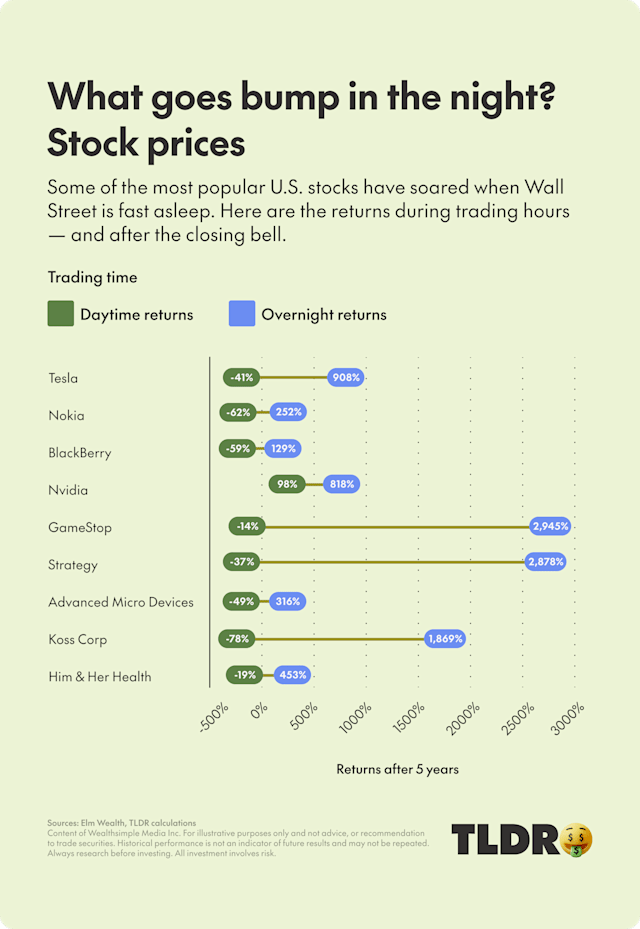
A couple of sane explanations for overnight drift:
1) Public companies report earnings after the bell, and most beat estimates — sending share prices up. 2) Europe starts trading around 2 to 3 a.m. Eastern, at which point U.S. markets have their largest positive returns. 3) Studies show that, though retail investors often make small trades early in the day, institutional investors tend to trade at the close, meaning stocks are repriced overnight.
Then there’s the juicy (but far-fetched!) theory that quant funds cheaply push up prices on stock they already own during overnight trading and then unload those positions into the market’s deeper daytime liquidity without giving back all the gains.
What does it all mean for you?
You probably shouldn’t fixate on any one market conspiracy. Why? Investors behave one way for a while, a pattern emerges, people try to take advantage of said pattern, then the advantage stops working. Just take the overnight drift: the Fed published a paper this month saying the anomaly has faded, as most market anomalies do over time. So if you hear of another market “conspiracy,” don’t fret — it might be gone by the time you wake up.

Written By
Jenna Benchetrit
Jenna Benchetrit is the senior business & markets reporter at TLDR, Wealthsimple Media's flagship financial newsletter. She was formerly a senior business writer at CBC News, where she covered economics and consumer issues for a Canadian audience.