Money & the World
Does Switching Jobs Actually Help You Get Ahead?
Making a change (or, rather, several changes) earlier in your career can put you on a completely different wealth trajectory. But money probably shouldn’t be the sole factor if you’re deciding whether to jump ship.
Wealthsimple makes powerful financial tools to help you grow and manage your money. Learn more
If you’ve found yourself adding “increasing shareholder value” to your list of hobbies on LinkedIn, odds are you’re looking for a new job. And if so, you’re among the 23% of Canadians who want to jump ship. The reasons are myriad: low pay, limited room to advance, the lingering embarrassment of sitting on a plate of potato salad at last year’s company picnic. OK, we made up that last one, but the fact remains: plenty of people are eyeing the exit. We looked at the freshest data to find out whether the hassle of switching jobs pays off.
First, will you make more money switching?
Last year, job stayers (at least in the U.S.) were enjoying higher wage growth than switchers, defying the truism that the fastest way to get a raise is to find a new job. Turns out, it was an anomaly. Bank of America tracked payroll deposits from 2019 through early 2026 and found that job switchers saw their after-tax pay grow by 8% from the year prior, compared with 5% for stayers. ADP data showed a similar gap in July.
Young switchers were the big winners. In the BoA report, Gen Z switchers posted more than four times the wage growth of Gen Z stayers, while millennial switchers gained at nearly twice the rate of their staying peers. Gen X and boomer switchers experienced flat or declining pay.
So what about Canadian switchers?
There’s no great source for switcher-versus-stayer wage data in Canada. So we asked TLDR readers about their job-hopping experience, and their responses were in line with the U.S. data: the majority got their biggest-percentage pay bumps — many as high as 50% — by switching early in their careers, and then many got another significant increase at around age 30, after which the switching premium shrank.
One hitch is that Canada’s job market isn’t as strong as America’s, so an 8% bump might be ambitious. But don’t let that dissuade you from going after a higher-paying job.
How does switching affect your earning power over your career?
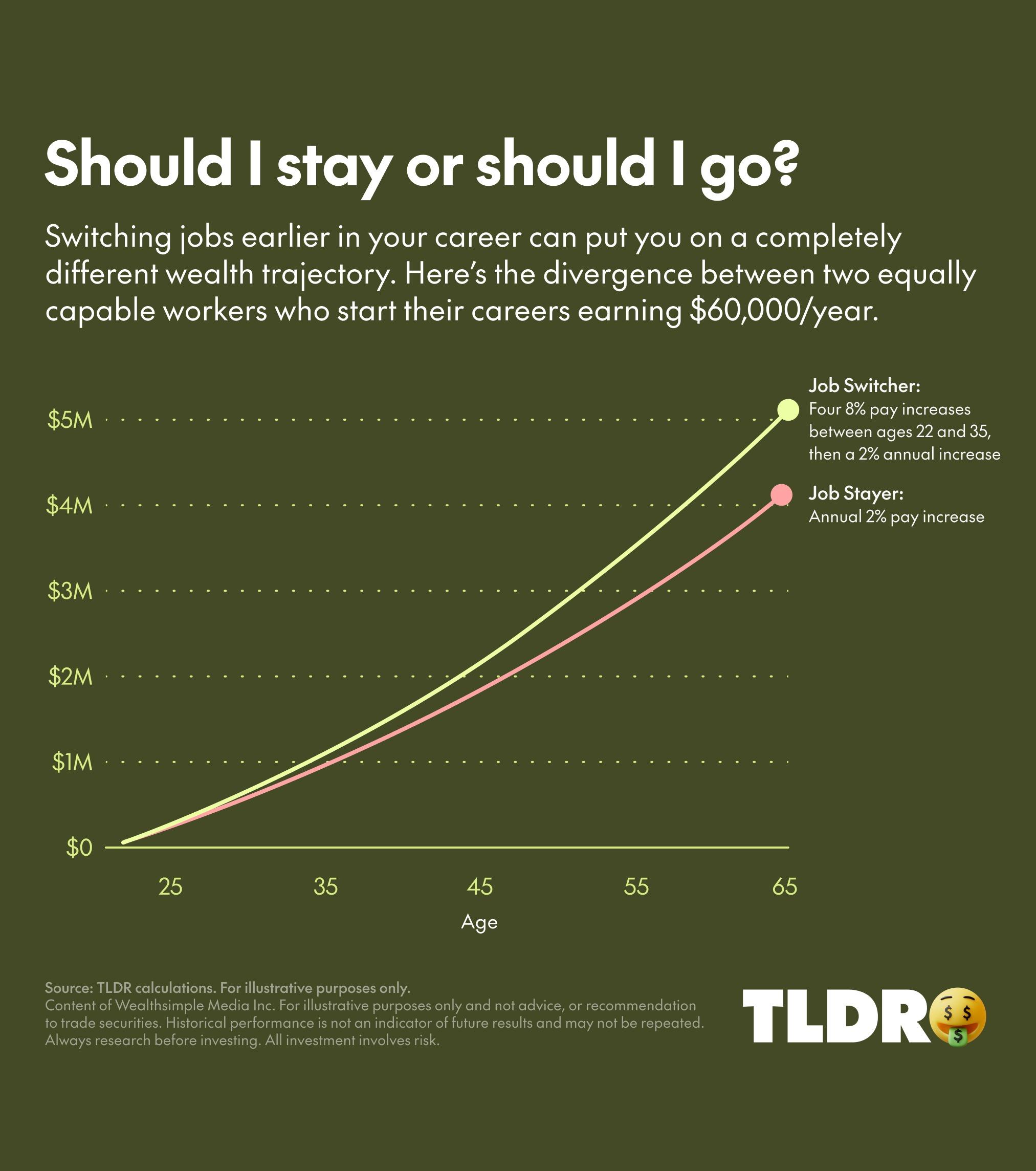
Here’s an example: John Stayer and Frank Switcher are 22 and equally capable, and they both make $60,000 a year. Stayer takes a 2% annual raise throughout his career, while Switcher changes jobs four times between ages 22 and 35, earning an 8% pay hike each time, after which he gets a 2% annual raise.
By age 65, Switcher has a salary of $177,000 compared to Stayer’s $141,000 — but, more impressive, Switcher has made something like $924,000 more in cumulative earnings. And if Switcher invested his excess money along the way, he would have $3.3 million more than Stayer, assuming a 7% annual return. That’s all back-of-the-envelope math that doesn’t account for taxes or inflation.
Can staying beat switching?
Sometimes! Top earners who remain in their jobs often get bigger pay increases than switchers. And in periods of job-market weakness, sticking with a secure job can beat taking a riskier, higher-paid position that fizzles out and leaves you unemployed.
There are nonmonetary reasons for staying too, right?
That’s true! Maybe you have great relationships with your colleagues or your job brings you deep satisfaction or offers a lot of flexibility, or maybe your company is prestigious and gives you clout. Trading any of those for a raise could be a mistake.
What should you do if you want a new job?
Remember: not all job hunters are created equal. You have to give companies compelling reasons to hire you, and the workers that do are usually driven; jobs with big pay bumps won’t just fall into your lap. So go in with eyes wide open and try to make yourself a desirable hire before blasting out résumés. And if you’re going to switch, ensure it’s a good match and a strategic move.

Written By
Abigail Covington is a features writer at the Philadelphia Inquirer and was previously a Contributing Editor at Esquire. Her work has been published in The New York Times, The Washington Post, Rolling Stone, and Pitchfork.