
Money & the World
Canada’s Hottest Job Market? Taking Care of Old People
The number of health-care jobs in Canada has swelled in recent decades. What does that tell us about the economy?
Wealthsimple makes powerful financial tools to help you grow and manage your money. Learn more
If you spend any time poking around fintwit, you’ve likely seen posts about how health-care jobs have been propping up the U.S. labour market. But did you know an identical trend is playing out here in Canada? From April 2025 to April 2026, the health-care and social-assistance industries alone added 119,000 jobs — a more than 4% YoY jump. Without those jobs, total employment would have contracted by 52,000. And this isn’t some weird blip. Health care has been one of Canada’s fastest-growing job segments for decades. But just how big has it become — and what does health care’s job dominance tell us about Canada’s economy?
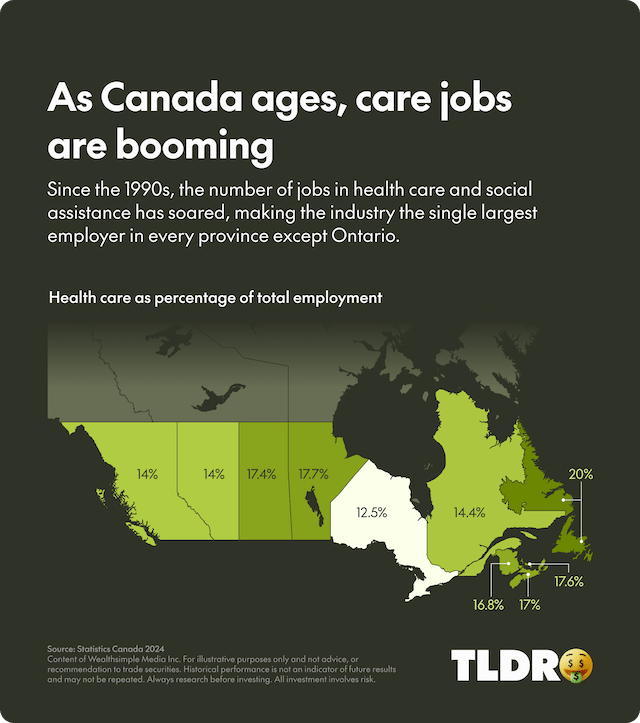
In the 1970s, manufacturing led the way, employing about 20% of the Canadian workforce. Today, the care sector — nurses, social workers, nannies, etc. — is the largest employer in every province except Ontario. All told, about 14% of Canadians work in the sector, and the total number of care-related jobs has more than doubled since 1997. That tells us two big things about Canada: we’re getting old! And we’re rich enough to afford lots of quality care!
One of the few sectors that has rivalled care’s growth is professional services, a catchall term for fields like architecture, advertising, finance, law, and tech. These white-collar jobs now employ 7% of Canadians, up from 4.7% in 1997.
Now let’s see which jobs are carrying the economy…
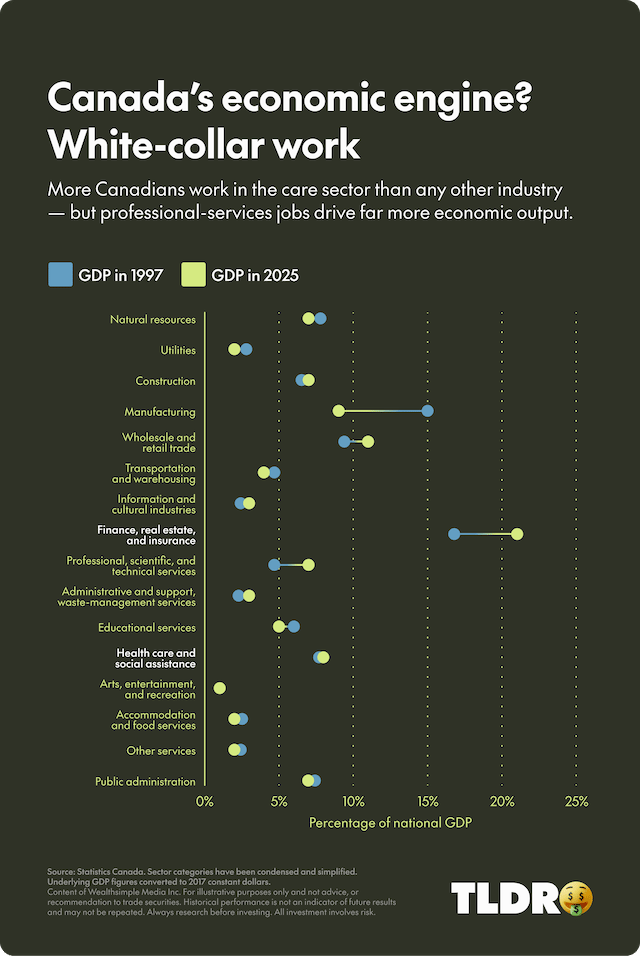
Health care and social assistance employ armies of people — but the sector contributes just 8% to GDP. White-collar industries employ about half as many folks but generate 21% of Canada’s economic output. Why? A real-estate firm, say, can generate heaps of money with minimal head count or overhead. Health care cannot.
The Upshot
The clearest micro takeaway is that if you’re in a care or white-collar industry, job opportunities should be abundant (maybe not right now but generally speaking). But unlike white-collar employees, care workers make below-average pay — in part because it’s a labour-intensive career and technology can only do so much to increase productivity, which gets reflected in wages.
Then there’s the macro trade-off: health care and elder care are largely cost centres (i.e., they’re not products that can be exported or scaled the same way as software, goods, or financial services). Don’t get us wrong: quality care improves living standards, which is good. Still, whatever cash we spend on care isn’t being invested in higher-productivity sectors, like R&D, where we’ve fallen behind. So care’s soaring growth says more about what Canada isn’t building than what it is.

Written By
Brennan Doherty
Brennan Doherty is an education writer and researcher for Wealthsimple. His work has appeared in the Toronto Star, The Globe and Mail, TVO Today, MoneySense, BBC Business, and other publications.